
Introduction
We have partnered with LayerZero, the leading interoperability protocol that has successfully transmitted over 135 million messages and facilitated the exchange of more than $60 billion in value. The integration of LayerZero V2 alongside our enhanced security measures delivers premier security for our users, all while maintaining a seamless user experience. Every aspect of the Ondo Token Bridge is developed with security in mind:- We’ve carefully selected a set of off-chain verifiers (a.k.a. DVNs), which guarantee strong security through independent actors (minimizing collusion risk) and disparate verification mechanisms (ensuring that even if a bug were to exist in one verifier, that verifier’s actions are mutually exclusive to the others and cannot compromise the overall system).
- We have worked with LayerZero to develop a custom rate limiting implementation and emergency pause feature.
- We have worked closely with a leading Web3 security firm and LayerZero Labs to vet all aspects of the configuration.
LayerZero Mechanism
At a high level, the LayerZero protocol is a mechanism to securely transmit messages across blockchains. Decentralized Verification Networks (DVNs) monitor for bridging events from source blockchains, validate these transactions, then post attestations to the destination chains. An executor submits a payload to the destination chain; if the executor’s payload and the DVN attestations match, the USDY or Ondo Stocks are minted to the recipient. Ondo has employed LayerZero’s OFT (Omnichain Fungible Token) standard to allow users to burn and mint native USDY and Ondo Stocks on all supported chains. Ondo Stocks assets also use the OFT architecture, but with a custom unified multi-asset configuration allowing all Ondo Stocks to be bridged through a unified framework instead of relying on separate bridge configurations for every token on every chain.DVN Selections
Our implementation of the OFT Token Bridge leverages the following independent verification mechanisms as DVNs to provide multiple redundant levels of security:- Canary DVN
- LayerZero Labs DVN
- Ondo DVN
Chain Availability
USDY
We currently support USDY transfers between Arbitrum, BNB Chain, Ethereum, Mantle, Sei, Solana, and Tempo. Stay tuned for more chain integrations coming soon.Ondo Stocks
We currently support Ondo Stocks token transfers between Ethereum, BNB Chain, HyperEVM, and Robinhood Chain. Stay tuned for more chain integrations coming soon.Rate Limiting
The bridge implementations contain a built-in rate limit feature in the smart contracts, enforcing both an outbound and an inbound limit. The capacity of the rate limiter refills at a linear rate, and blockchain transactions attempting to exceed the rate limit capacity will revert. This security measure enforces an upper bound on the amount that can be transferred per-pathway over a (configurable) 24 hour period.USDY
EVM ↔ EVM (Arbitrum, BNB Chain, Ethereum, Mantle, Sei, Tempo)
- The outbound limit is 450,000 USDY per pathway per day.
- The inbound limit is 500,000 USDY per pathway per day.
Solana ↔ EVM (Arbitrum, BNB Chain, Ethereum, Mantle, Sei, Tempo)
- The outbound limit is 250,000 USDY per pathway per day.
- The inbound limit is 300,000 USDY per pathway per day.
Ondo Stocks
Ondo Stocks transfers are currently supported between Ethereum, BNB Chain, HyperEVM, and Robinhood Chain, and are rate-limited separately from USDY:- Approximately $450,000 per day, per Ondo Stocks asset, per direction
- Limits apply to each individual asset (e.g., AAPLon, NVDAon, SPYon)
- Hyperliquid routes default to approximately $180,000 per day, except for the select high volume tokens (NVDAon, TSLAon, CRCLon, GOOGLon, SLVon) which get the standard limits.
FAQ
Can I specify a different destination address for my transfer?
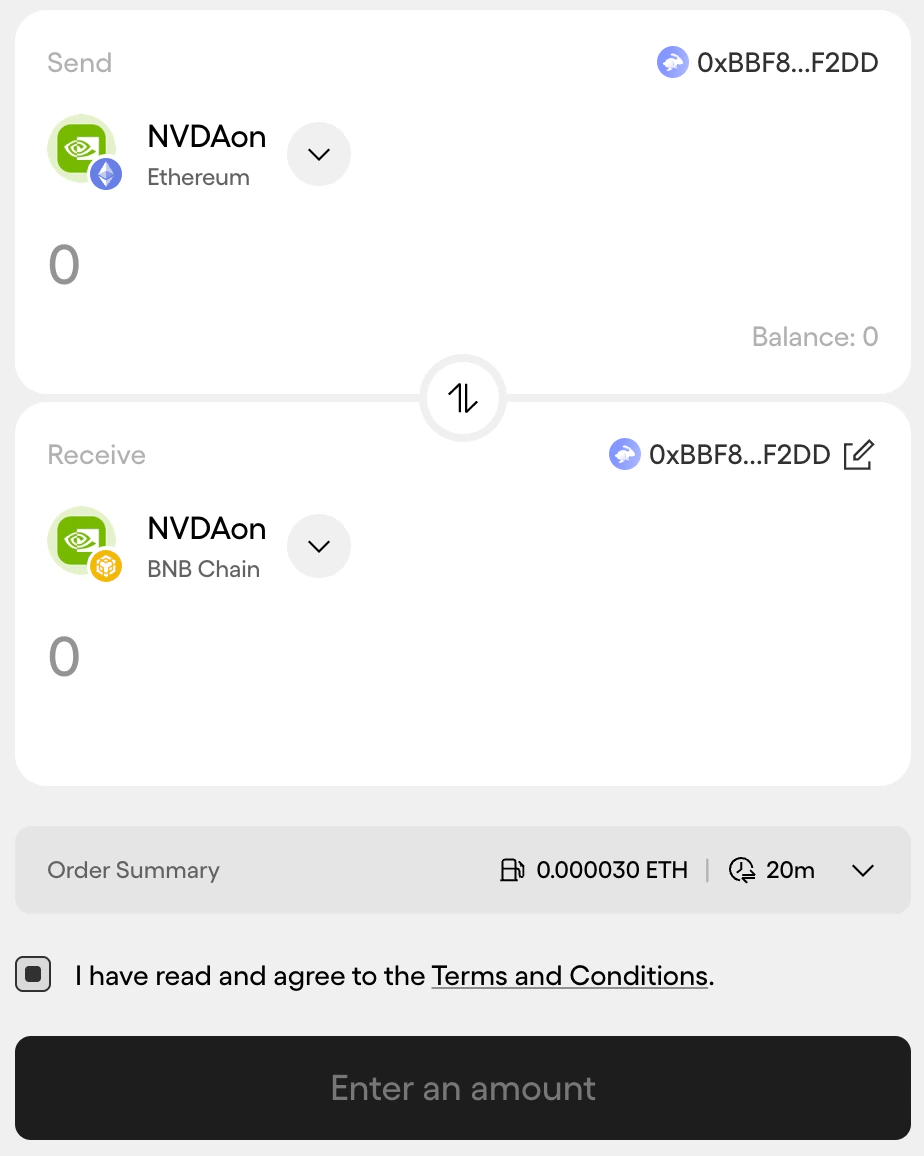
Yes - Ondo’s bridge webpage allows the user to specify a different destination address.- First, click the edit (pencil) icon next to the address in the Receive section.
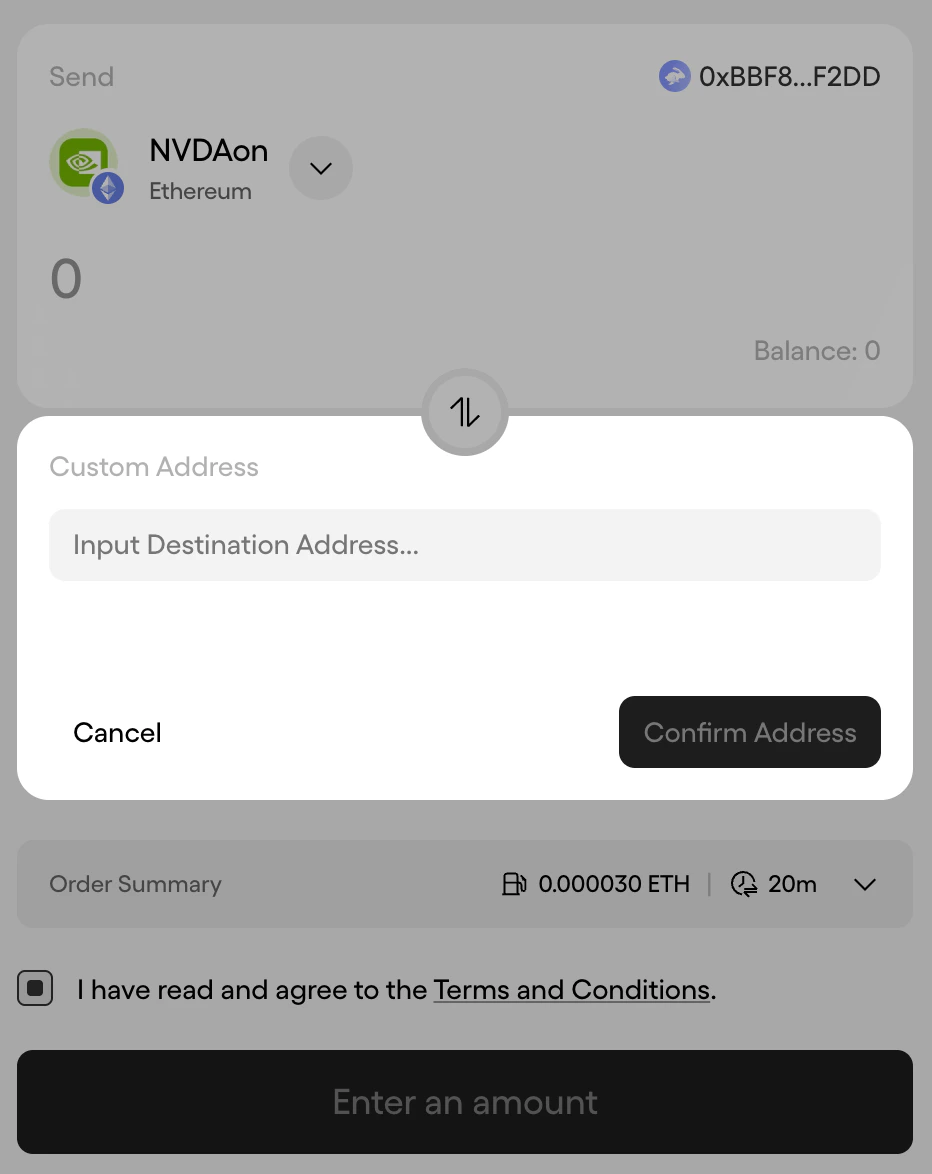
- Next, input the destination address and click Confirm Address.
Are there any fees associated with transferring tokens?
Transferring tokens comes at no fee on the USDY or Ondo Stocks token amount — you’ll receive the same amount of tokens on the destination chain as you’re sending from the source chain. However, there are two types of fees paid in the native token of the source chain (such as ETH):- Standard gas fees: You will pay for the normal gas cost to publish the transaction to the source chain, just like you would for any other transaction. This is handled automatically by your wallet.
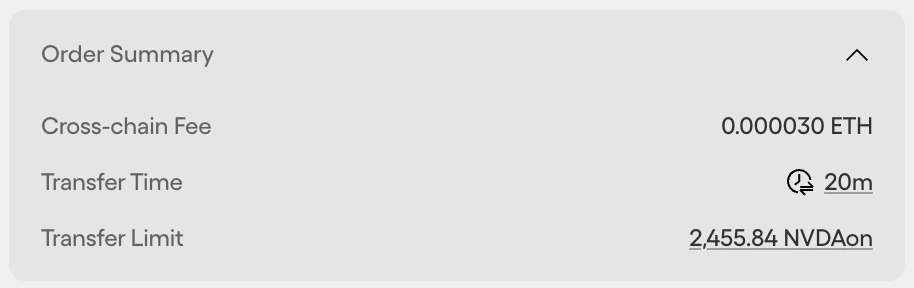
- Cross-chain gas fees: Both LayerZero and the DVNs will receive gas fees for publishing your transaction to the destination chain. This is shown under Cross-chain Fee in the Order Summary section.
How long do transfers take?
Transactions take between 1 and 30 minutes to complete depending on the selected chain path. The tokens will automatically be sent to the recipient wallet on the destination chain. In cases of network congestion, this may be delayed up to 24 hours.Are there any bridging best practices?
When bridging tokens across blockchains, it’s highly recommended to perform a small test transfer before committing to a larger transaction. This allows you to verify that the bridge is functioning correctly, confirm that you’re using the right address and blockchain network, and ensure any fees or delays are clearly understood. Test transfers reduce the risk of potential loss or issues caused by misconfiguration or unforeseen problems during cross-chain transfers.My transaction is pending or has failed. What should I do?
In most cases, you can resolve this on your own. Check LayerZero Scan- Check the status on the LayerZero explorer. Paste your source chain transaction hash into the search bar at https://layerzeroscan.com.
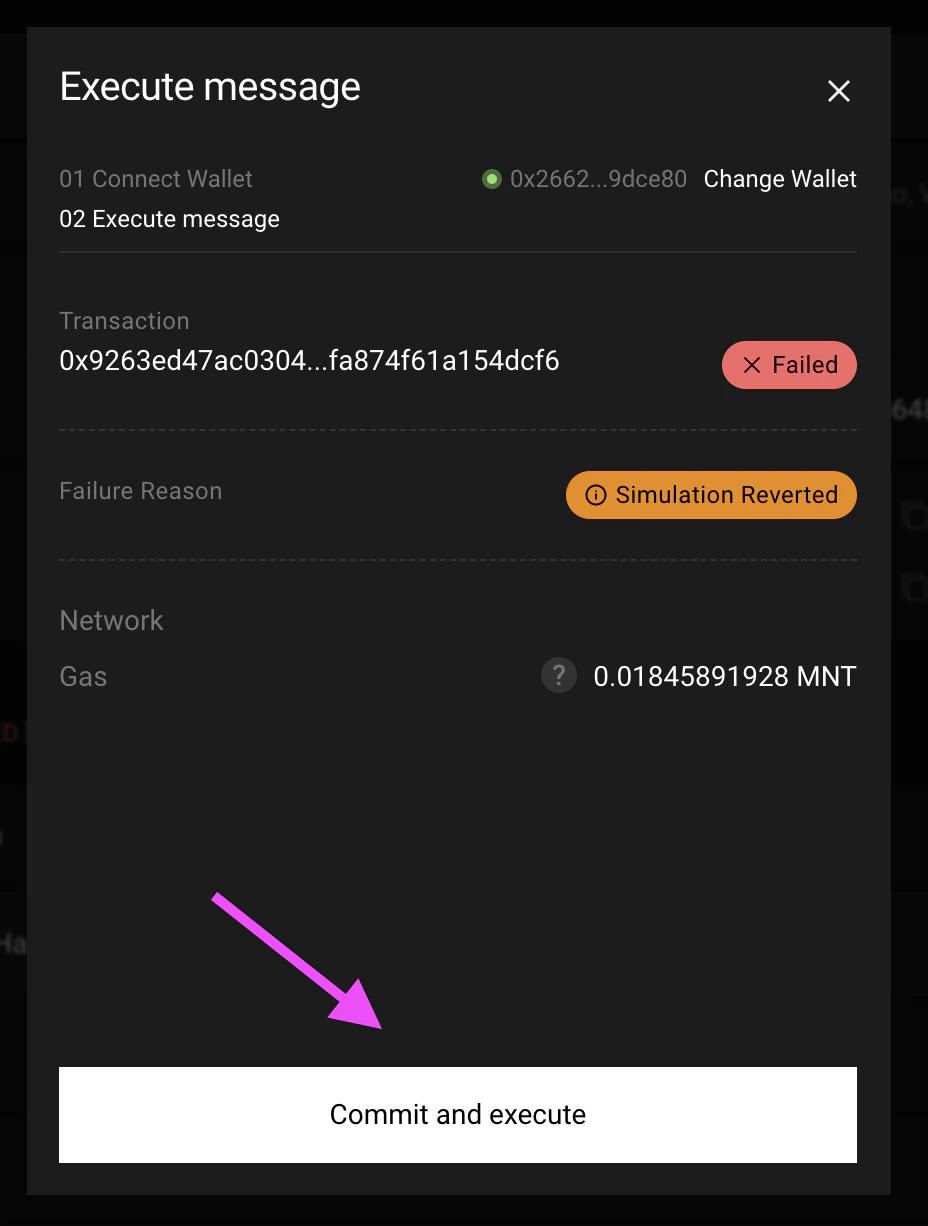
- On the right-hand side of the page, there may be an Execute button. Click this, and connect your wallet.
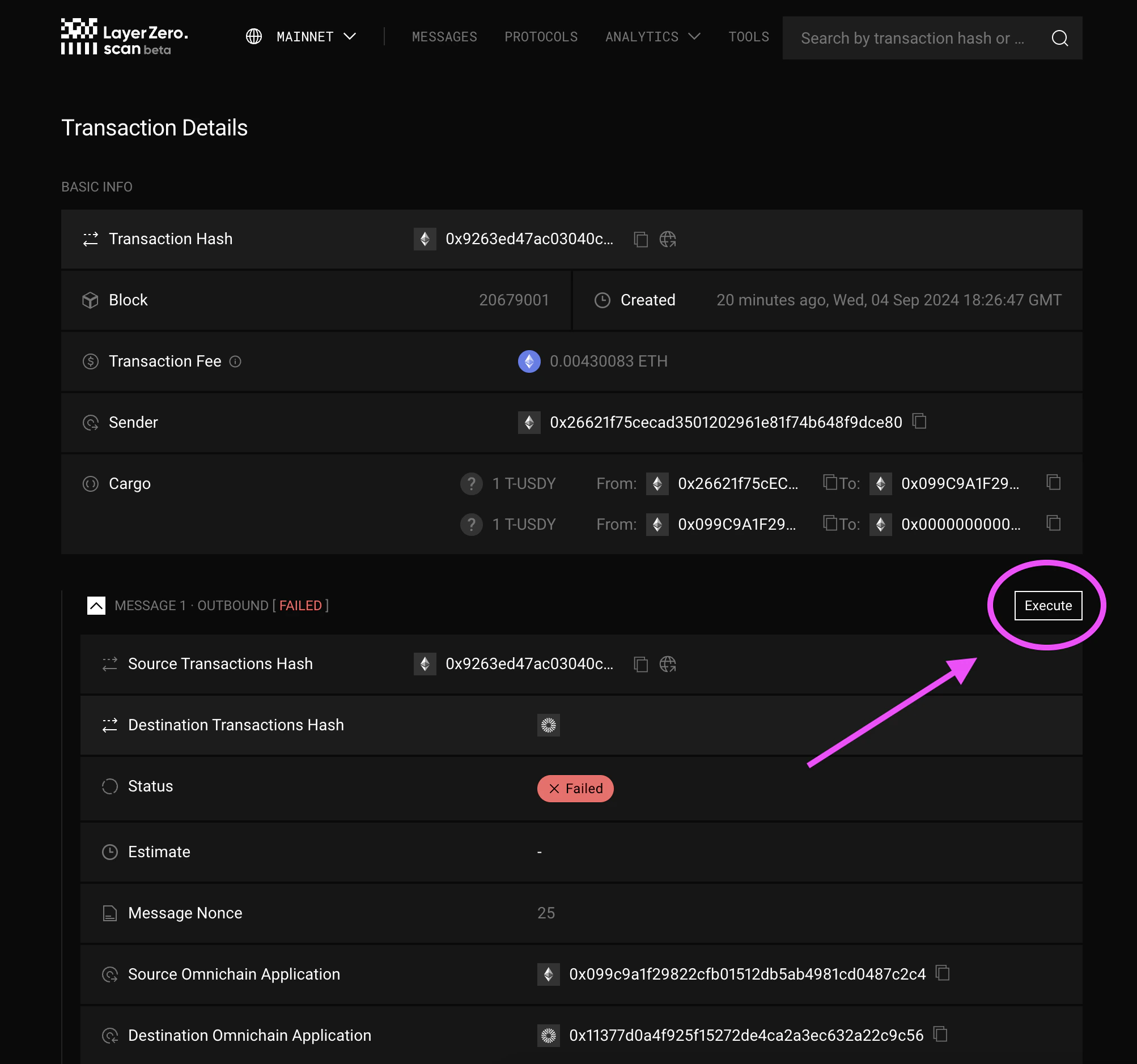
- In the provided window, click Commit and execute.